


If you’ve recently got into football, you might find it difficult to get your head around the actual size of a pitch. If you’ve been visiting your local club, you might see various age groups kitting out on different-sized pitches, five-a-side teams playing within smaller spaces, and professional players competing on even larger pitches. Watching how small players seem in comparison to the space on television only adds to the confusion. While players start on smaller pitches at younger age groups, the standard football pitch used for adult matches is approximately 105 metres long and 68 metres wide. Understanding the size of a football pitch also involves knowing the dimensions of its various markings, from the halfway line and centre circle to the penalty area and corner arcs. In this article, we’ve covered all aspects of the football pitch so that, by the time you’re finished reading, you’ll know its dimensions inside and out.
| Marking | Measurement (meters) |
|---|---|
| Touchline (Length) | 90–120 m |
| Goal line (Width) | 45–90 m |
| Goal | 7.32 m wide, 2.44 m high |
| Penalty Area | 40.32 m wide, 16.5 m deep |
| Goal Area | 18.32 m wide, 5.5 m deep |
| Penalty Spot | 11 m from goal line |
| Centre Circle | 9.15 m radius |
| Corner Arc | 1 m radius |
| Offside Mark | 9.15 m from halfway line |


How Big Is a Football Field?
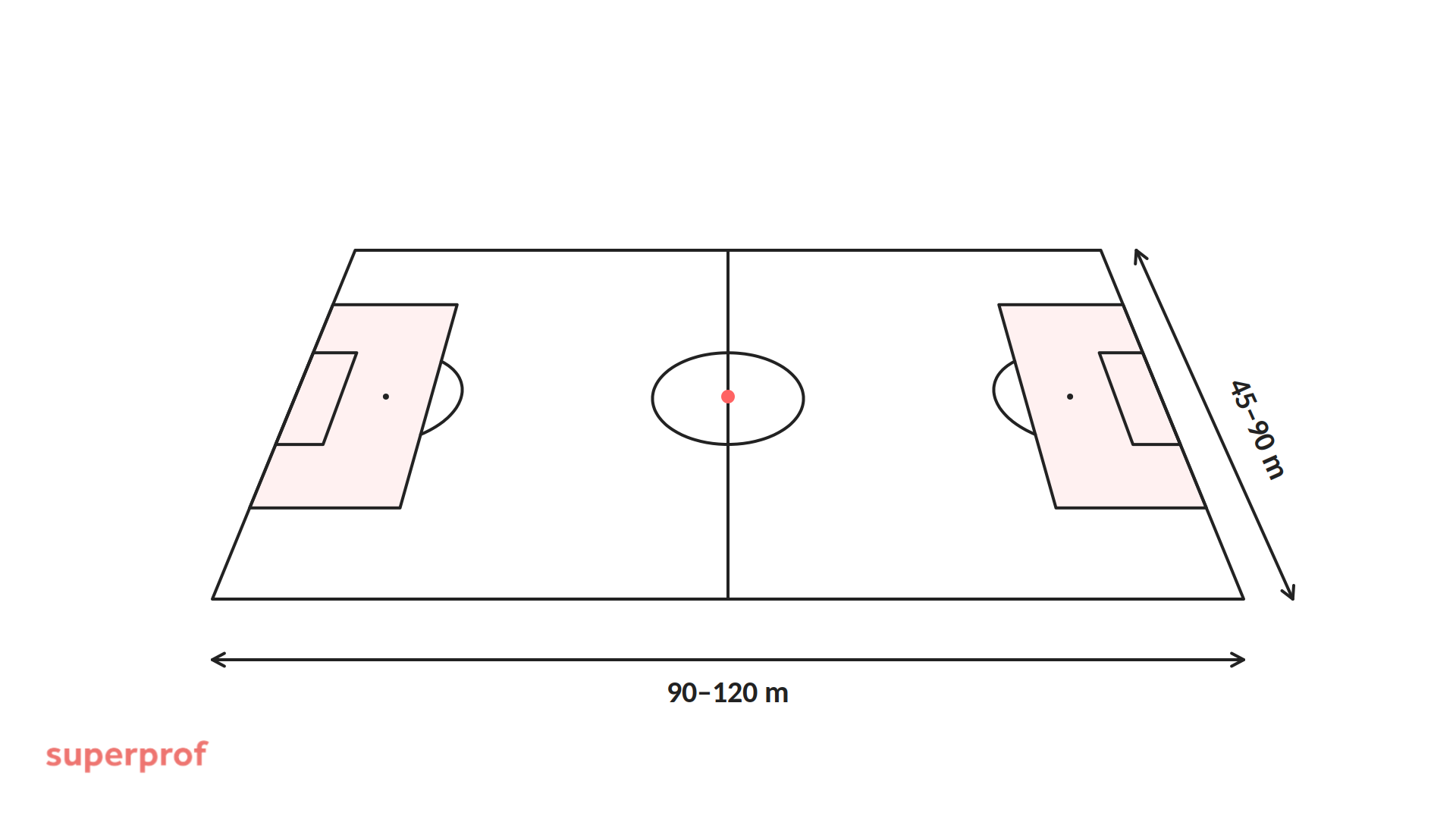
When it comes to the game’s rulebook, an adult football pitch must measure between 90 and 120 metres long and between 45 and 90 metres wide. This variation depends on the stadium and competition. That said, at the professional level, pitches are generally 105 metres long and 68 metres wide.
The Permitted Range and Why It Exists
The first thing that might jump out at you is the question of why there is such a wide range of permitted sizes for a football pitch. Well, older stadiums, community pitches and modern professional venues don’t always have the same layout. This variation in dimensions accounts for these differences while maintaining a consistent framework for the game.
If you put your thinking cap on, you’ll see that the size of the playing surface can influence the strategies that suit a particular match. For instance, if you know your team will be playing on a longer pitch, having a pair of pacier wingers is something that could definitely pay off in your match strategy. Understanding offside in soccer becomes easier when you know how the halfway line, penalty areas and players’ positions relate to one another.
The Narrower Range for International Matches
There’s less leeway when it comes to the international stage. For these fixtures, the pitch must measure between 100 and 110 metres long and between 64 and 75 metres wide. These narrower ranges help ensure consistency when international sides meet, as their matches are played in more comparable environments.
Every Marking on the Field
All those lines that a groundskeeper spends hours painting onto the pitch define its boundaries and identify areas where specific rules apply. Let’s go through each of them so you know why they’re there in the first place.
Touchlines and Goal Lines
Let’s start from the outside and work our way in. Perhaps the most defining lines are those that mark the perimeter of the pitch. The two touchlines run along the longer sides of the pitch, while the two goal lines mark its shorter ends. If the ball completely crosses any of these lines, it is out of play, and a throw-in, corner kick or goal kick may follow, depending on the circumstances. Even the lines themselves must follow specific dimensions: they cannot be wider than 12 centimetres.
The Halfway Line, Centre Circle and Centre Mark
Drawn at the halfway line, this circle ensures that opposing players stay at least 9.15 meters away from the ball during a kick-off at the start of the game.
The line cutting across the rectangular pitch is known as the halfway line. It does exactly what its name suggests: it marks the halfway point of the pitch and runs through the centre mark. This centre mark is where every football match begins with kick-off. It’s also where play restarts after each goal. A circle with a radius of 9.15 metres surrounds this point and is known as the centre circle.
The Penalty Area
The penalty area is where much of the exciting action takes place throughout a match. Whether it’s a close-range shot or a penalty kick, this is where plenty of decisive moments occur.
The term refers to the large rectangular area directly in front of the goal at each end of the pitch.
This section of the pitch follows strict guidelines, extending 16.5 metres from the goal line.
Learning about soccer positions helps you understand how teams use different areas of the pitch during attacking and defensive phases.
In addition to being the area where fouls can result in penalty kicks, it is also where the goalkeeper is permitted to handle the ball, subject to the game’s rules. The goalkeeper is free to explore the entire pitch of course, but this is the area where he's allowed to use his hands.
The Goal Area (Six-Yard Box)
Next, we’ve got the goal area, which is the smaller rectangle inside the penalty area. This area extends 5.5 metres from the goal line and 5.5 metres to either side of the inside edges of the goalposts. It’s commonly known as the six-yard box because these dimensions are approximately six yards. The goal area also has an important role in the game, as it determines where goal kicks can be taken.
The Penalty Spot and Penalty Arc
We’ve already touched on the penalty area, but the penalty spot itself is another important feature. During normal play, the referee can award a penalty kick if the defending team commits a direct-free-kick offence inside its own penalty area, subject to the Laws of the Game. The penalty spot is positioned 11 metres from the midpoint between the goalposts.
This is the exact spot where the ball is placed for a penalty kick, located centrally between the goalposts and 11 meters out from the goal.
The penalty arc is the curved marking immediately outside the penalty area. It has a radius of 9.15 metres from the penalty spot and helps ensure that players remain the required distance away from the ball during a penalty kick.
Corner Arcs and the Technical Area
Although they might not be as obvious when you’re watching a match on television from the comfort of your living room, the corners of the pitch have small arcs marking where the ball can be placed for a corner kick. Each arc has a radius of one metre from the corner flag. An easy way to spot these areas is to look for the flagposts positioned at each corner of the pitch.
Goal Dimensions
We’ve touched on how adult football pitches can vary somewhat in size, but this isn’t the case when it comes to the goals. Their dimensions remain consistent across professional football.
Width, Height and the Rules on Posts and Nets
If you’ve played football at a competitive level, you’ll know first-hand how every inch matters when it comes to the size of the goals. It can be the difference between a shot hitting the post and deflecting into the net or going wide. So, if you’re watching an adult match, you can be sure that the goal you’re seeing is 7.32 metres wide and 2.44 metres high. The goalposts and crossbar must also be the same width, with a maximum diameter of 12 centimetres.
Junior and Small-Sided Pitches
If you’ve ever seen younger age groups take to the pitch or have memories of playing as a child, you’ll likely have seen much smaller goals. These smaller pitches and goals are deliberately used to help children develop their skills while ensuring that the distances involved remain appropriate for their age and ability. Even the fittest players can find it physically demanding to run the length of a full-sized pitch, let alone children with much shorter legs.
5-a-Side, 7-a-Side and 9-a-Side Dimensions
Another situation in which you’re likely to encounter smaller pitches is small-sided football. For instance, five-a-side pitches often measure around 25–42 metres long and 16–25 metres wide. In most instances, you'll find a football field size in feet or meters.
With far fewer players occupying the space, the smaller pitch encourages quick passing, close control and frequent involvement in the game.
It’s a very different experience from playing on a full-sized pitch.
Seven-a-side pitches tend to be slightly larger, measuring around 50–60 metres long and 30–40 metres wide.
The arrangement of players depends heavily on the team’s soccer formation, which determines how space is occupied across the field.

Meanwhile, nine-a-side football uses pitches measuring approximately 70–80 metres long and 45–55 metres wide. These differences in size can significantly influence the style of play that unfolds during matches. So, when you're asking what is the size of a football field, there are actually a few correct answers to that question
What Youth Football Actually Uses
If you’re ever passing a youth match at your local club or watching a tournament, one thing that’s likely to stand out is that younger players often compete in five-a-side, seven-a-side or nine-a-side games as they develop. These smaller playing areas give them more opportunities to pass, dribble, defend and shoot. Eventually, as these players grow and develop their skills, they transition to playing on a full-sized pitch.
Pitch Surfaces
As you can see, several factors influence the type of football pitch players can expect to play on. To add another consideration to the list, factors such as climate, available budget and expected playing frequency also influence the surfaces on which the game is played.

Football pitches use different surfaces depending on the climate, available budget and expected playing frequency. In most cases, pitches are made of natural grass, but artificial turf and hybrid surfaces offer alternatives for grounds with different requirements. You'll also find that indoor football field size changes quite a bit too!
Natural Grass
- Feel: Softer surface that reduces impact injuries but can become slippery or muddy in wet weather.
- Maintenance: High maintenance, requiring mowing, watering, and rest periods between matches.
- Play Style: The ball rolls true but speed varies depending on grass length and soil moisture.
- Best For: Professional stadiums where player comfort and tradition are priorities.
Artificial Turf
- Feel: Firmer surface with higher friction, which increases the risk of turf burns and joint stress.
- Maintenance: Low maintenance, needing only regular brushing and debris removal to stay playable.
- Play Style: Consistent ball speed and bounce regardless of weather, often resulting in a faster game.
- Best For: Community pitches and schools that need high availability year-round.
Natural Grass
Natural grass is what most football players are used to playing on. However, you might be surprised to learn just how much pitch maintenance can affect the playing experience. Factors such as movement and player traction depend on the grass, soil, moisture and maintenance. Regular mowing, watering and repairs are therefore essential, which is why many clubs have their own dedicated groundskeepers.
Artificial Turf
If you’ve played five-a-side football yourself, there’s a good chance the game took place on an artificial turf pitch. These surfaces use synthetic fibres designed to replicate some of the characteristics of natural grass. One of the main advantages is that they generally withstand heavy rainfall and frequent use better than natural grass, making them a practical option for facilities that host numerous matches.
Hybrid Surfaces and Where They’re Used
Hybrid pitches are perhaps the least familiar of the three main surface types, as they’re also less common. Essentially, they combine natural grass with synthetic reinforcement, offering some of the benefits of both materials. They come with a heftier price tag, so they’re mostly found in professional stadiums or at facilities that cater for frequent matches.
Now, we’ve covered just about everything there is to know about football pitches. You’ll know the pitch like the back of your hand the next time you head out to play, as well as have a better understanding of how different pitch sizes can influence the strategies teams use.
Summarise with AI:
Did you like this article? Leave a rating!

 Loading...
